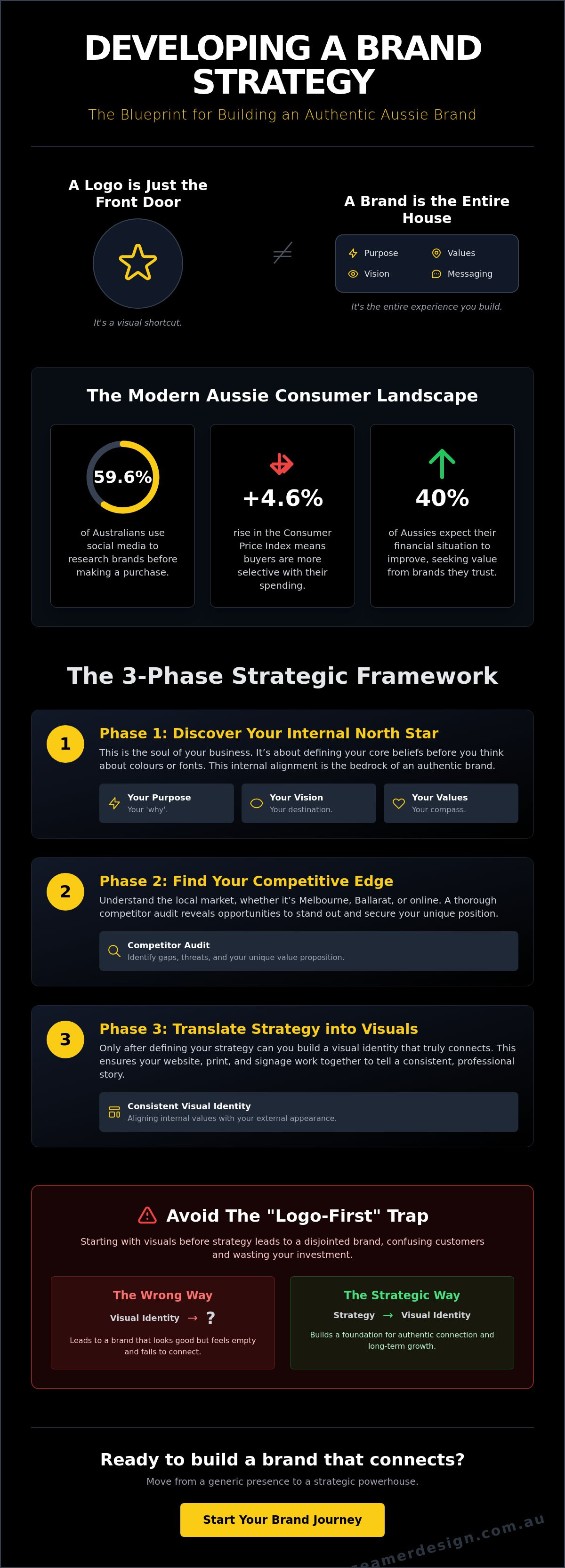
Your logo is not your brand; it is just the front door to a house that might be empty. In a market where 59.6% of Australians use social media for brand research, looking "nice" is no longer enough to win. You likely feel the pressure of a crowded landscape where messaging feels inconsistent and your budget feels stretched. Mastering how to develop a brand strategy is the only way to stop shouting into the void. It is about moving beyond the visual surface to build a foundation that creates an authentic, human connection.
We understand the frustration of being a local champion that feels invisible. It is draining to invest in design that fails to convert or capture your true value. This guide provides the clarity you need to move from a generic presence to a strategic powerhouse. We will show you how to align your goals with a roadmap for growth that resonates with the modern Aussie consumer. Expect a deep dive into defining your unique value and building a brand that feels both visionary and grounded.
• Move beyond the logo. Establish a strategic foundation that defines your "why" and builds genuine trust with your audience.
• Master how to develop a brand strategy that uncovers your unique value proposition and secures your competitive edge in the Australian market.
• Conduct a thorough competitor audit to understand how your business can stand out in crowded local landscapes like Melbourne or Ballarat.
• Align your internal values with external visual identity. Create consistency across website design, print, and signage to ensure a professional and unified presence.
• Transform your business goals into a living roadmap. Use strategic insights to guide every creative decision and drive authentic customer connection.
Brand strategy is the pulse of your business. It is the intentional "why" behind every "what" you deliver to the market. While many mistake a logo for a brand, the reality is far deeper. Your logo is the face; your strategy is the personality, the brain, and the soul. A face without a brain is just a mask. In a landscape where 59.6% of Australians use social media for brand research, your strategy ensures that what they find is a cohesive, trustworthy story rather than a collection of pretty pictures.
Learning how to develop a brand strategy is a commercial necessity in 2026. With the Consumer Price Index rising by 4.6% in the 12 months leading up to March 2026, Australian consumers are tightening their belts. They are becoming ruthlessly selective. A bespoke strategy allows you to move beyond the race to the bottom on price by building an emotional bridge with your audience. Template-led approaches might save money today, but they fail to capture the nuance of your specific story, leading to a weak return on investment over time.
A robust Brand Strategy serves as the blueprint for your market presence. It begins with your internal North Star: your purpose, vision, and values. These are not just words for a boardroom wall. They dictate how you treat customers, how you hire staff, and how you behave when the market gets tough. When these elements align, you build Brand Equity. Brand Equity is the cumulative value of customer trust. This trust is what allows a business to weather economic shifts and maintain loyalty when competitors are faltering.
It's tempting to rush straight into Visual Identity Design. Aesthetics are exciting and tangible. However, starting with design before intent leads to "disjointed brand" syndrome. This happens when your visuals promise one experience, but your service delivers another. The result is a confused customer who quickly looks elsewhere. Strategy provides the brief that makes design work harder for your bottom line.
Consider a heritage-focused firm in Ballarat. If they invest in a hyper-modern, clinical visual identity simply because it is "on trend" for 2026, they risk alienating their local community. By first understanding how to develop a brand strategy that respects their local relevance and unique value, they ensure their design feels authentic. Strategy ensures your brand looks, talks, and acts like a leader in its specific niche, whether you are operating in the heart of Melbourne or a regional hub.
• Strategy defines the "why" and "how" of your business operations.
• Bespoke strategies offer higher long-term ROI than generic templates.
• Visuals must be a reflection of a deeper strategic intent.
• Authenticity is the primary currency for Aussie consumers in a high-inflation environment.
Building a brand starts from within. It is about identifying the core beliefs that will drive your business forward through 2026 and beyond. When you investigate how to develop a brand strategy, the first step is always internal discovery. You need to define your Brand Purpose. This is not about your bottom line. It is about the change you want to create for your clients. Whether you are a boutique in Melbourne or a large firm in Ballarat, your purpose is what makes your audience care. In a year where 40% of Australians expect their financial situation to improve, they are looking to spend their money with brands that stand for something meaningful.
Your Brand Vision is your destination. It is a bold, aspirational statement that gives your team a reason to show up every day. It transforms a job into a mission. While your vision looks to the future, your values ground you in the present. Many businesses can explain "what" they do. Few can articulate "how" they do it differently. Your "how" is where your competitive advantage lives. It is the signature style or unique methodology that makes your service irreplaceable. This internal alignment is the bedrock of a successful Brand Strategy.
The "heart" of your business is rarely found in a spreadsheet. It is uncovered through rigorous discovery sessions that challenge your assumptions. A Mission Statement is your roadmap; it describes what you do every day to serve your customers. A Purpose Statement is your "why." It is your reason for existing beyond profit. In 2026, authenticity is the primary currency for Australian brands. Consumers are weary of "corporate speak." They want to see the human element behind the brand. This transparency builds the trust necessary for long-term growth.
Values must be active. They are the guardrails for your culture and your market behaviour. We recommend choosing three to five core values that actually drive business decisions. If "Creative Catalyst" is a value, it should manifest in how you solve problems for clients. These values are the DNA of a bespoke brand identity, ensuring that every touchpoint feels intentional. From your Visual Identity Design to your Environmental Graphics, your values should be felt by anyone who interacts with your business. When your internal culture matches your external image, you create a powerful, unified brand presence.
Standing out in the Australian market requires more than just a loud voice. It requires a distinct position. To understand how to develop a brand strategy that actually wins, you must first map the terrain. This begins with a rigorous competitor audit. Look beyond the surface level of Melbourne or Ballarat firms. Analyse their messaging, their visual cues, and their customer touchpoints. You aren't just looking for what they do well. You are looking for what they ignore. This gap is where your opportunity lives.
Your Unique Value Proposition (UVP) is the cornerstone of this phase. It is a clear statement of the functional and emotional benefits only you provide. In 2026, loyalty is driven by transparency and value. With the Consumer Price Index rising by 4.6% in the 12 months leading up to March 2026, Aussie consumers are more discerning than ever. They don't just want a product; they want a partner who understands their specific challenges. Positioning your brand in the "white space" of the market ensures you aren't fighting for scraps in a crowded category. You are owning a space that belongs only to you.
Data tells you who your customers are, but empathy tells you why they buy. We use Empathy Maps to dive deep into the pains and aspirations of your audience. This moves beyond basic age or location brackets. A boutique agency approach prioritises human connection. It seeks to understand the "mental load" of a business owner in regional Victoria or the aspirations of a Melbourne professional. By segmenting your audience, you can tailor your message for maximum impact. This ensures your Visual Identity Design and Website Development speak directly to the right people without losing your core brand consistency.
Visualising your brand against competitors is a powerful exercise. We plot your business on a matrix to see where the market is saturated and where it is empty. Are you the luxury alternative in an accessible market? Are you the modern disruptor in a traditional industry? This clarity prevents you from becoming a "me-too" brand. Market Differentiation is the strategic choice to be different, not just better. It is about leaning into your unique strengths to create a bespoke presence. When you find that specific gap, your brand becomes the obvious choice for your ideal client.
A successful brand does not happen by accident. It is the result of a deliberate, methodical process. Understanding how to develop a brand strategy involves more than a single brainstorming session. It requires a commitment to digging deep into your business's DNA and the market's demands. This five-step framework provides the structure needed to move from a vague idea to a powerful market presence. It is a roadmap for growth that bridges the gap between your current state and your desired future.
Conduct internal workshops and stakeholder interviews to uncover the "why" behind your work.
Research competitors and audience psychographics to find your unique space.
Finalise your purpose, values, and brand personality.
Craft a compelling brand story that places your customer at the centre of the journey.
Create a strategic brief that guides the creative team in developing your visual identity.
Discovery sessions are the bedrock of a visionary brand. These workshops should be collaborative, involving voices from across your organisation to unearth untapped potential. Don't ignore the insights of front-line staff; they often understand customer pains better than anyone. Combine these internal views with local market intelligence. In Melbourne and regional Victoria, consumer expectations are high. Use local data to build a SWOT analysis that highlights your strengths and identifies market vulnerabilities. This intelligence ensures your strategy is grounded in evidence rather than assumptions.
Once the intelligence is gathered, you must find your voice. Your Brand Voice should act as an authoritative yet supportive partner to your clients. It needs to be consistent across every touchpoint, from your website to your packaging. Write a brand story that resonates on a human level. Place the customer as the hero. Your business is the guide that helps them achieve their goals. This narrative sets the tone for all future creative experiences. It provides the clarity needed to lead your market with confidence. If you're ready to start this journey, partner with Seamer Design to build your strategic foundation.
This strategic work then flows directly into Step 5: Visual Translation. Your strategy acts as the filter for every design choice. It ensures that your colour palette, typography, and imagery aren't just aesthetic choices. They are strategic tools used to reinforce your position. When your visuals are rooted in these pillars, your brand becomes a cohesive and powerful asset that drives real business growth.
Your strategy is the soul, but visual identity is the body. It is the physical manifestation of your intent. Once you have mastered how to develop a brand strategy, the transition to design must be seamless. A strategic brief acts as the translator. It ensures that every colour choice, font pairing, and image style is rooted in logic rather than personal preference. For instance, a brand focused on sustainability might lean into earthy tones and organic textures, while a tech firm might prefer high-contrast, minimalist aesthetics. These choices aren't just decorative; they are strategic tools that reinforce your position in the market.
Consistency across touchpoints is the hallmark of a professional business. In 2026, where 74% of Australian advertising spend is digital, your brand must work across fragmented screens and physical spaces. Whether it is your website design, print collateral, or environmental graphics in a Ballarat storefront, the experience should feel identical. Custom design beats templates every time. Templates are built for everyone, which means they are built for no one. A bespoke approach ensures your high-end identity reflects your specific value proposition and builds the trust required for conversion.
We bridge the gap between strategic thought and creative execution. A visionary brand needs to feel aspirational, yet it must remain grounded in the reality of its customers' lives. This balance is critical for local growth. Our professional graphic design Ballarat services help regional businesses compete on a national stage by elevating their visual presence. We take your strategic pillars and turn them into a visual language that speaks volumes before a single word is read. It is about creating a look and feel that is as intentional as your business goals.
Your Brand Identity Manual is the gatekeeper of your reputation. It should include clear rules for logo usage, colour palettes, typography, and tone of voice. This manual ensures that every new marketing campaign or creative idea aligns with the foundation you built during the discovery phase. Use your strategy as a filter. If a new idea doesn't fit the purpose you defined earlier, it doesn't belong in your brand. This discipline prevents brand dilution and ensures long-term ROI. Ready to elevate your brand? Partner with Seamer Design for a bespoke strategy session and turn your vision into a powerful, unified reality.
Your brand is more than a logo; it's a promise kept. By defining your internal North Star and finding your competitive edge, you move from being a commodity to being the only logical choice. Mastering how to develop a brand strategy ensures your business remains resilient and relevant in a shifting Australian economy. It bridges the gap between your current state and a visionary future where every touchpoint feels intentional and grounded. Consistency is the key to building the cumulative trust that defines market leaders.
True market leadership requires a partner who understands the local landscape. With over 20 years of creative excellence, our award-winning Melbourne and Ballarat team acts as a strategic partner for both national and local brands. We don't just execute tasks; we deeply understand and champion your commercial goals. It's time to stop feeling invisible in a crowded market and start leading with professional confidence. A well-crafted strategy is the catalyst for your business's next phase of growth.
Elevate your brand with Seamer Design’s bespoke strategy services. We are ready to help you build a strategic foundation that creates authentic connections and drives measurable success. Let's start your transformation today.
Developing a comprehensive strategy typically takes between four and eight weeks. This timeframe allows for deep discovery workshops, rigorous market research, and the synthesis of your brand's unique narrative. Rushing this process risks creating a surface-level identity that lacks the strategic weight needed to drive long-term growth.
You can certainly begin the internal discovery, but an external partner brings the objectivity required to see your business as the market does. It is often difficult to read the label from inside the jar. Professional guidance ensures your foundation is built to scale and avoids the common pitfalls of "me-too" positioning.
Brand strategy is your "why" and your long-term identity; a marketing plan is your "how" and your short-term tactics. Strategy defines your personality, values, and market position. The marketing plan is the roadmap for how you will use specific channels to communicate that identity to your audience over a set period.
A deep review should occur every three to five years to ensure you remain relevant. However, you should assess your strategic alignment annually. If your business goals change or the Australian market shifts, a refresh helps you maintain your position as a visionary leader and a supportive partner to your clients.
Success can sometimes lead to brand drift, where your daily operations lose touch with your original purpose. A clear strategy protects your legacy while providing a framework for future expansion. It ensures your success is sustainable and repeatable rather than a result of market luck or temporary trends.
The most frequent error is starting with Visual Identity Design before defining the strategic intent. Other mistakes include ignoring local competitor research and failing to involve key stakeholders in the process. These oversights often lead to inconsistent messaging and design that fails to convert your target audience.
Measure success through increased brand awareness, improved customer loyalty, and stronger internal team alignment. You should also track conversion rates on your website and the quality of new business leads. A successful strategy makes every subsequent creative decision easier and more effective for your bottom line.
Your core purpose stays the same, but your positioning needs to account for a different competitive landscape. Melbourne is a more saturated market with distinct audience expectations. Learning how to develop a brand strategy for a metropolitan context helps you bridge the gap between your regional roots and your new urban audience.